
Irregular Verbs In English
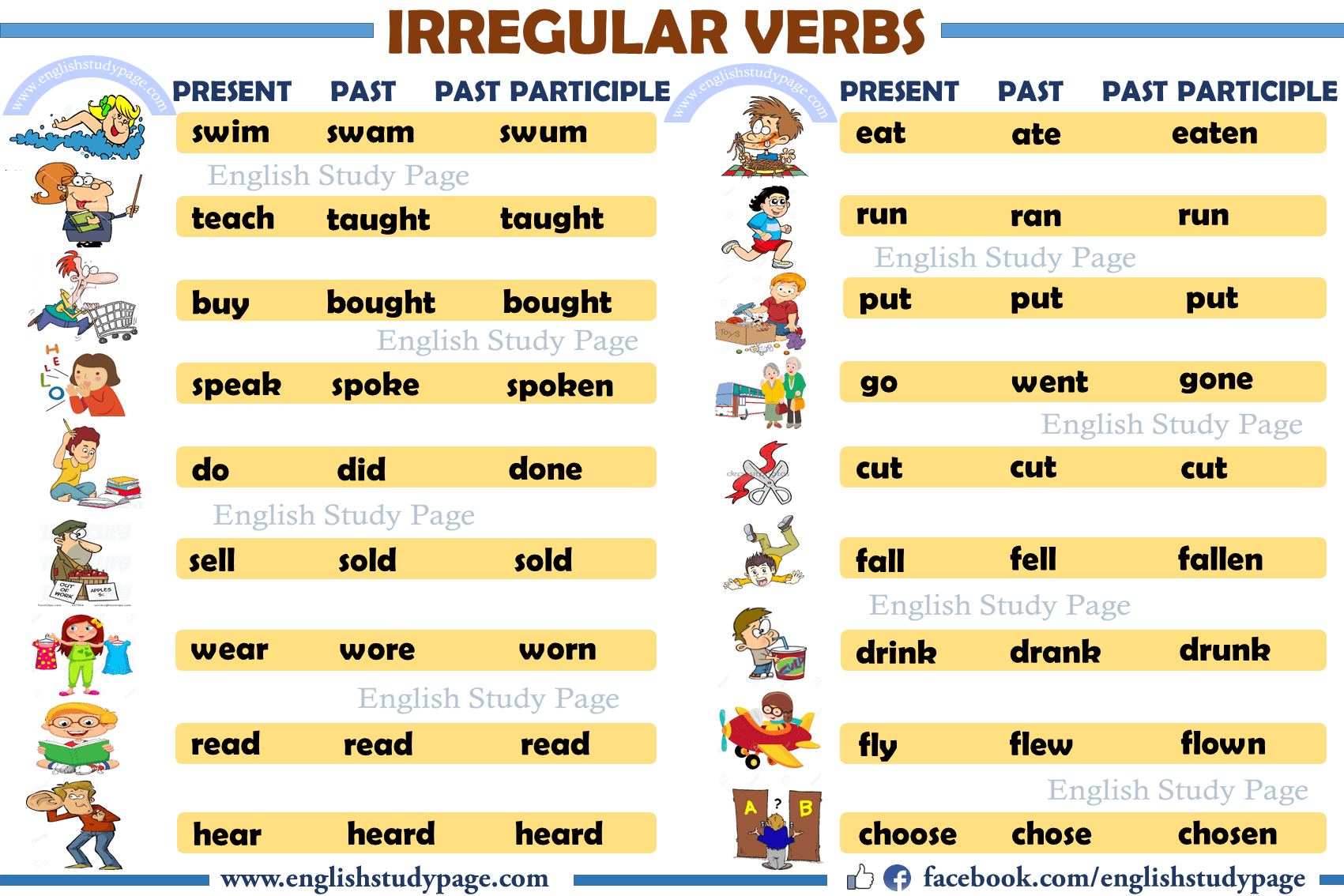
100 Most common English irregular verbs, list of irregular verbs in English. This is a list of Irregular Verbs.
Just when you finally think you understand English grammar and all the different tenses, you discover irregular verbs.
Over 180 English verbs are called irregular verbs, and they break all the rules.
Most words in the English language follow the rules: today I use, yesterday I used.
Present Tense Irregular Verbs In English
Past tense gets an -ed. Simple!
Irregular verbs are a pain because there isn’t one rule you can learn for them. They don’t follow the pattern. You just have to memorize them.
It could be worse, though. Many years ago, Old English had twice as many irregular verbs as modern English. Over the years, these verbs and how we used them changed, and we ended up with our much simpler modern language.
Imagine a game of Broken Telephone. This is a game where everyone sits in a circle, one person chooses an English sentence and whispers it to the person sitting next to them, and then, one by one, everyone whispers the same sentence in their neighbor’s ear. Little by little, the original sentence is changed until it comes out completely different after it has made its way around the circle.
As Harvard professor Steven Pinker puts it: “Every time we use an irregular verb, we are continuing a game of Broken Telephone that has gone on for more than five thousand years.”
Irregular Verbs In English Wikipedia
How to Recognize an Irregular English Verb
Knowing the history of irregular verbs is interesting, but it doesn’t help you learn them. To study irregular verbs, first you should understand what irregular verbs are.
Regular verbs always follow the same pattern. They look the same in the past and are easy to form. Usually all you have to do is add the letters -ed at the end of the word!
Here are some examples:
I work, I worked, I had worked.
He laughs, he laughed, he had laughed.
Irregular verbs, though, don’t follow that pattern. You can recognize them because they look so different in the past tense.
Some examples:
I write, I wrote, I had written.
He builds, he built, he had built.
An English verb is irregular when it doesn’t end in -ed in the simple past tense and past participle form. Not sure what those are? Here’s a simple way of looking at it:
- The simple past tense describes any action that takes place before right now.
- Regular verb: I worked for 40 hours last week.
- Irregular verb: I spoke to my best friend yesterday.
- The past participle is used in other English tenses that have an auxiliary (or “helping”) verb. For example, the past perfect tense uses the auxiliary verb “have” + the past participle of your main verb to describe an action that happened and ended in the past.
- Regular verb: I had worked for the company for only 6 months when I decided to leave.
- Irregular verb: I had spoken at over 50 schools by the time I turned 30.
How Common Are Irregular English Verbs?
Many of the most common verbs are irregular, so learning them is important!
Some words that you use every day in conversations are irregular. You may need to tell someone that you’ve already begun working on the new project at work. Or you might want to tell a friend: “I saw you in the park yesterday, but I didn’t say anything because I thought you were busy.” See how both the words saw (past tense of see) and thought (past tense of think) are irregular?
The list of irregular verbs is not a very long one, when you consider that there are over a million words in the English language! It can still be tough to learn them, if you don’t know where to start.
The first thing to do is to just look at a list. You can find a list of irregular verbs in the English language right here.
And now, to learn them! Luckily, there are some tips you can use to make learning irregular verbs easier.
1. Group common irregular verbs together
Irregular verbs don’t follow any rules, which is what makes them so hard to remember. But some irregular verbs follow a similar pattern. Instead of learning the verbs in alphabetical order, try putting them in similar groups.
How you group the verbs depends on whatever is easiest for you, but here are a few suggestions:
- Verbs that remain the same in the present, past and past participle.
- Examples: cost and set.
- Verbs that are the same in the past forms, but not the present.
- Examples: breed, bred and shoot, shot.
- Verbs that end in -en in the past participle.
- Examples: speak, spoken and wake, woken.
Look through the list of irregular verbs and find patterns of your own!
2. Learn all new vocabulary with its tense forms
You can make irregular verbs easier for yourself in the future by just learning them right from the beginning. Every time you learn a new verb, learn its tenses as well.
Don’t just learn that to steal means to take something without permission. You should also learn that its simple past tense is stole and its past participle is stolen.
3. Memorize the 10 most common irregular verbs first
Not all irregular verbs are commonly used. You might never use a word like broadcast, and you’ll probably only see the word abide as part of the phrase law-abiding citizen (that’s someone who follows the law).
Instead of going through the list in alphabetical order, focus on the most commonly used words first.
Start with these very common words (they’re listed as present, past, past participle):
- Say, said, said
- Go, went, gone
- Come, came, come
- Know, knew, known
- Get, got, gotten
- Give, gave, given
- Become, became, become
- Find, found, found
- Think, thought, thought
- See, saw, seen
That’s right, all these tiny but very important verbs are irregular! You’ll need to know their irregular forms to use them in everyday conversation.
4. Turn memorizing into a game
You might have no problem remembering the irregular verbs using flashcards, but if you’re having trouble why not turn it into a game?
There are a few games online that can make remembering the verbs fun and easy. The British Council has a quiz-like game, the MacMillan Dictionary has a verb wheel, and Quia has a game similar to Jeopardy.
You can even make your own game with index cards: write the verb and their past or past participle (or both) on separate index cards. Then turn all the cards over in front of you with their backs up.
Now you can play a memory game. Turn a card over, then another. If the two cards match, leave them face up. If they don’t, turn them back over and try again.
5. Learn in sentences
It might be easier to remember the words when they’re part of a sentence of a phrase. Learn words by putting them into sentences, and you’ll also be learning how to use them correctly.
To learn the word see, for example, you can use sentences like this: “I see the bee, I saw the snow, but I’ve never seen a bee in the snow!”
Be creative—the weirder the sentences are, the easier they will be to remember. You can use rhymes, keep the sentences short or create an entire story using as many verbs as you can. How you do it is up to you, as long as it helps you remember the verb forms.
6. Learn with songs
Another great way to give the words more meaning is through using music. You can find many songs for remembering irregular verbs on YouTube. Here are three of the best:
- FluencyMC uses a catchy rap song to teach the forms of some of the most common irregular verbs.
- This adorable cat video tells a story while teaching the verbs.
- Schoolhouse Rock is a classic cartoon with fantastic music you’ll be singing for days after you hear it.
7. Leave lists where you can see them
Sometimes just memorizing is the best way to go. To make this easier for you, divide up the verbs in groups of 5 to 10 words (you can group them alphabetically, by how common they are or by the groups we suggested earlier in this article).
Write the verbs out on paper, and leave them in spots where you can see them throughout the day. Tape the list up behind your coffee maker, on your table, even on the bathroom wall! Looking at the list just a few minutes a day can be enough to remember them.
Once you feel that you’ve remembered the full list, move on to the next group of verbs.
8. Ask people to correct you
Nothing beats practicing—but practicing correctly is important too! Whenever you’re speaking to an English speaker, ask them to correct you if you make a mistake when you speak. This is great not just for irregular verbs, but for any of your English speaking.
Make sure you can accept their correction without getting upset or discouraged. Remember, they’re helping you!
After reading all these tips, that list of irregular verbs doesn’t look so scary anymore, does it?
If you liked this post, something tells me that you'll love FluentU, the best way to learn English with real-world videos.
In contrast to regular verbs, irregular verbs are those verbs that fall outside the standard patterns of conjugation in the languages in which they occur. The idea of an irregular verb is important in second language acquisition, where the verb paradigms of a foreign language are learned systematically, and exceptions listed and carefully noted. Thus for example a school French textbook may have a section at the back listing the French irregular verbs in tables. Irregular verbs are often the most commonly used verbs in the language. In linguistic analysis,the concept of an irregular verb is most likely to be used in psycholinguistics, and in first-language acquisition studies, where the aim is to establish how the human brain processes its native language. One debate among 20th-century linguists revolved around the question of whether small children learn all verb forms as separate pieces of vocabulary or whether they deduce forms by the application of rules. Since a child can hear a regular verb for the first time and immediately reuse it correctly in a different tense which he or she has never heard, it is clear that the brain does work with rules, but irregular verbs must be processed differently. Historical linguists rarely use the category irregular verb. Since most irregularities can be explained historically, these verbs are only irregular when viewed synchronically, not when seen in their historical context. When languages are being compared informally, one of the few quantitative statistics which are sometimes cited is the number of irregular verbs. These counts are not particularly accurate for a wide variety of reasons, and academic linguists are reluctant to cite them. But it does seem that some languages have a greater tolerance for paradigm irregularity than others.
Below you will find our complete list of printable irregular verbs worksheets. Lists are arranged in several different formats so that you can use the one that best suits your needs. Irregular verbs are difficult to understand, because they do not follow normal verb tense rules. Therefore, it is necessary to memorize them individually. It is also very helpful to understand the Simple, Participle, and Perfect aspects of the past, present, and future tense.
Irregular Verbs Lists
List of Irregular Verbs Arranged in Alphabetical Order.
List of Irregular Verbs Arranged by Pronunciation Change.
List of Irregular Verbs with Endings that Never Change due to Tense. Verbs in this List Always Stay the Same No Matter What.
Irregular Verbs That Change Worksheets
Irregular Verbs that Stay the Same Worksheets
We hope you found everything you needed on our website. Just remember that this is copyrighted work to be used only by teachers in school or at home. Binding, bookmaking, and or collation of our worksheets, reproduction and or duplication of our worksheets on other websites, and or use of our worksheets for commercial gain is strictly prohibited.